A half-billion-year-old fossil has been discovered with its internal organs still intact, according to a recent study published in the journal Nature.
A joint team of scientists from the Earth Sciences Department at Durham University in the United Kingdom and Yunnan University in China analyzed a 520-million-year-old larva from the Cambrian Period, which was roughly 540 million to 485 million years ago. Incredibly, the fossil’s internal organs, including its brain, remained preserved.
The larva is a forerunner to the modern arthropod family, which encompasses centipedes, crabs, insects, and spiders. It belongs to an ancient template which now makes up about 80 percent of all animal species in the world, meaning their body evolved in such a way that they were adaptable to a variety of environments. “The Cambrian radiation of euarthropods can be attributed to an adaptable body plan,” the researchers wrote in their paper.
Yang Jie / Zhang Xiguang/Nature)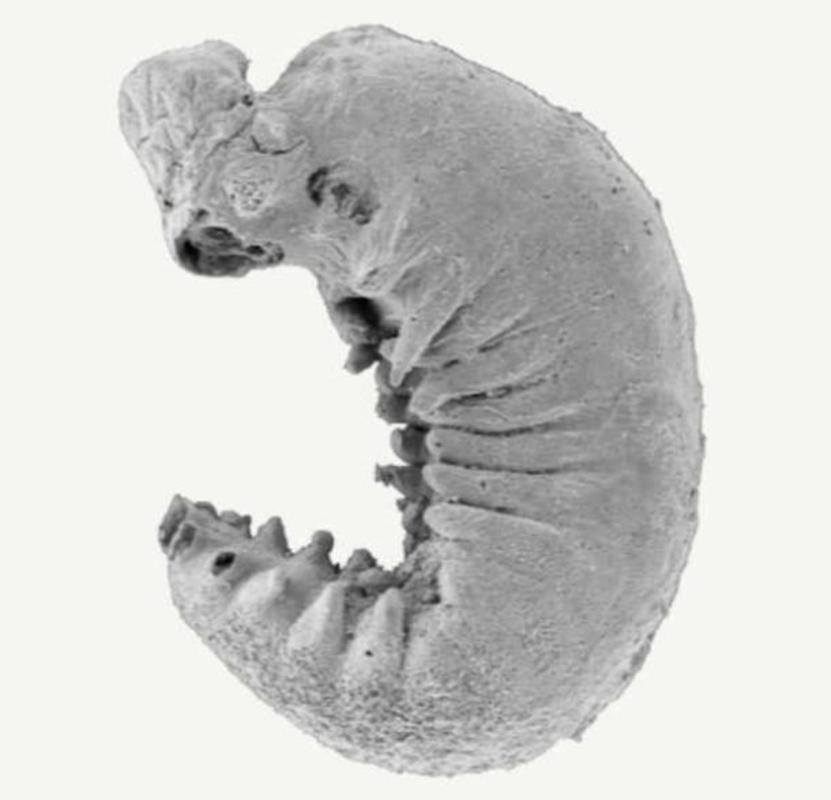
Yang Jie / Zhang Xiguang/Nature)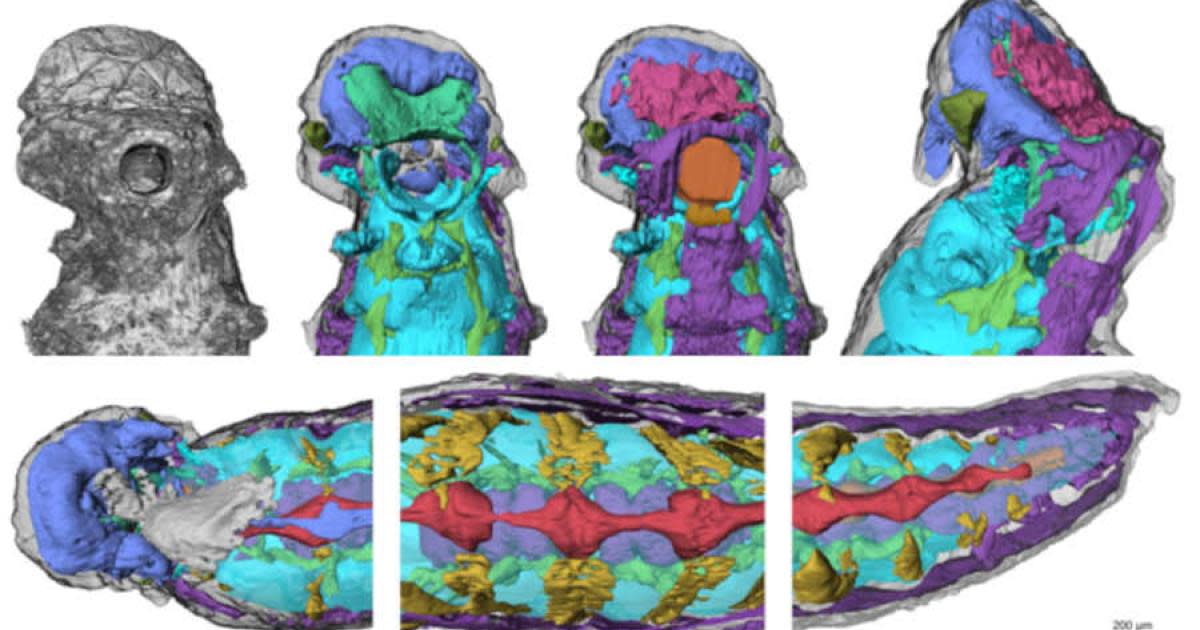
‘My Jaw Just Dropped’
“I already knew that this simple worm-like fossil was something special, but when I saw the amazing structures preserved under its skin, my jaw just dropped,” lead study author Martin R. Smith said in a press release. “How could these intricate features have avoided decay and still be here to see half a billion years later?”
Emma J. Long/Nature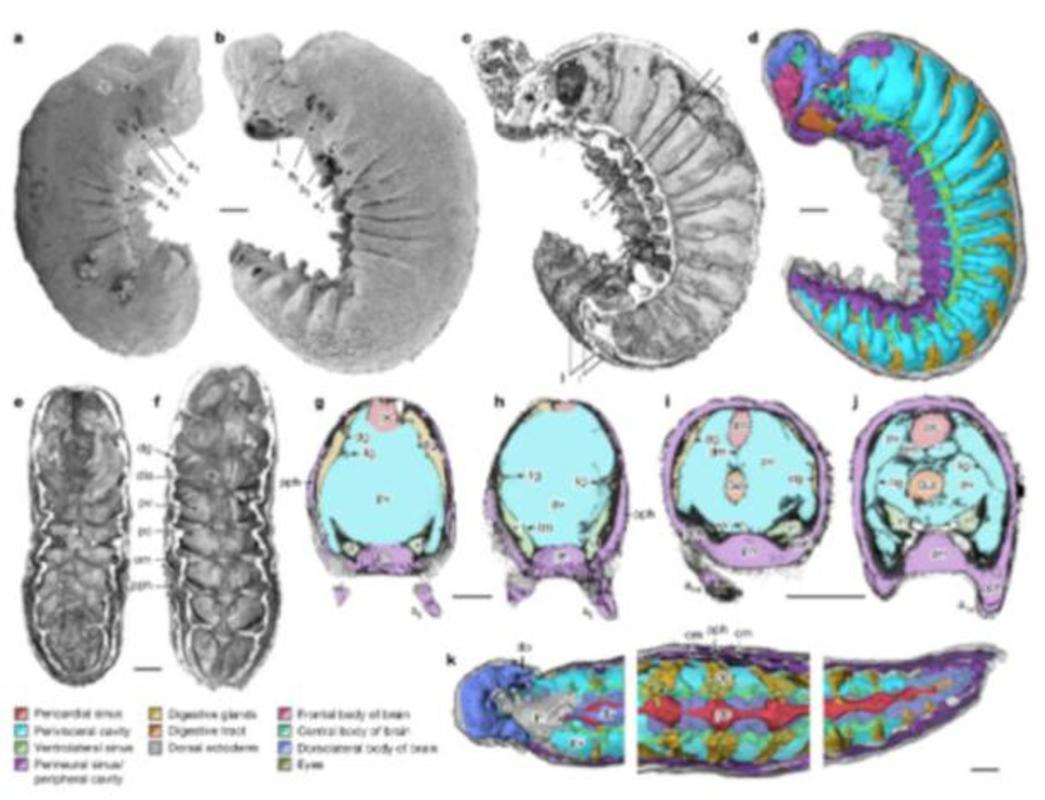
3D Models Were Created of the Fossil’s Body
The fossil was recovered from shale rock in China’s Yu’anshan Formation, long known for its myriad fossil discoveries. The larva was then analyzed using X-ray computed tomography equipment, with the images used to generate 3D recreations of its brain, digestive tract, circulatory system, and the nerves connecting its brain to “primitive ‘legs’ and ‘eyes.’”
“When I used to daydream about the one fossil I’d most like to discover, I’d always be thinking of an arthropod larva, because developmental data are just so central to understanding their evolution,” Smith said. “But larvae are so tiny and fragile, the chances of finding one fossilized are practically zero – or so I thought!”
The fossil is being kept at Yunnan University. Smith and the rest of the researchers are hopeful that they will be able to identify Cambrian larval specimens, which will further illuminate ancient animal evolution.