Archaeologists with Mexico’s National Institute of Anthropology and History have discovered a bizarre square-shaped skull which revealed a previously unknown deformation practice in the region, per Greek Reporter.
Bizarrely Shaped Skull Indicates Ancient Deformation Practices
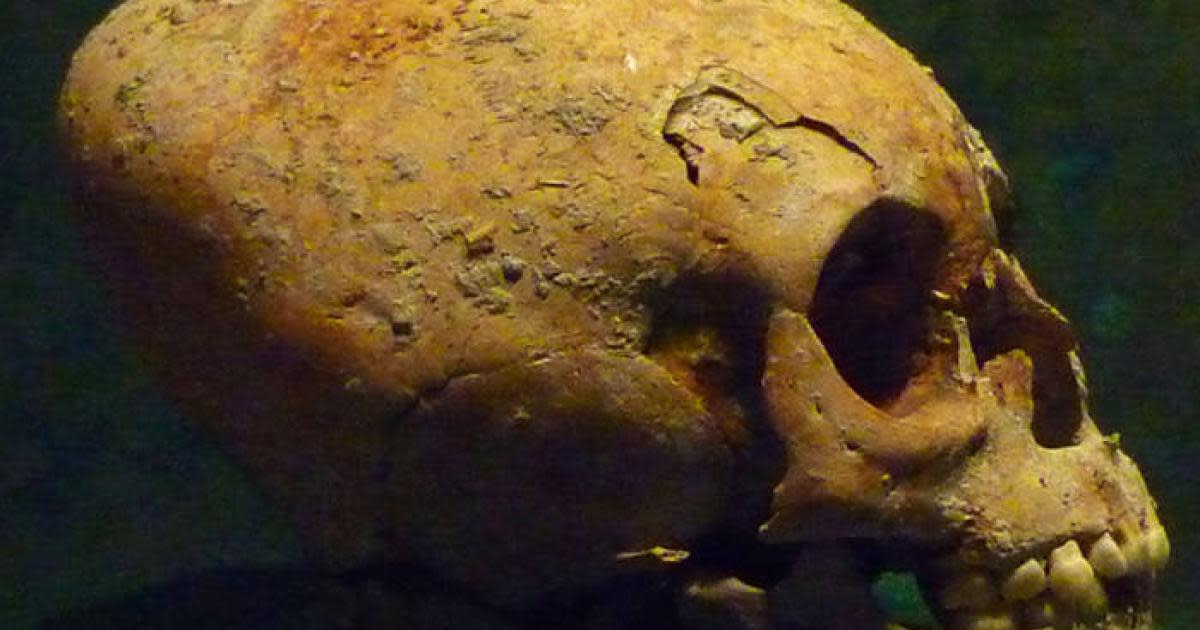
The skull, discovered in the northern Huasteca region, belonged to an adult male over 40 years old who lived in the Mesoamerican Classic period between 400 A.D. and 900 A.D. The area is now the Balcón de Montezuma archaeological zone in Tamaulipas. Physical anthropologist Jesús Ernesto Velasco González confirmed that intentional cranial deformation rituals were practiced at the site. Experts say the skull has a “tabular erect” deformation with a distinctive superior plane, creating what scientists have described as a “cube-like” appearance.
“This form is tabular superior, named by some specialists given the polyhedral aspect it provokes in the cranium, where the compressive plane extends from the lambda over the occipital angle to the sagittal suture in the parietals,” González explained. “This causes the head to display a more square shape, unlike the conical form typical of other modifications.”
INAH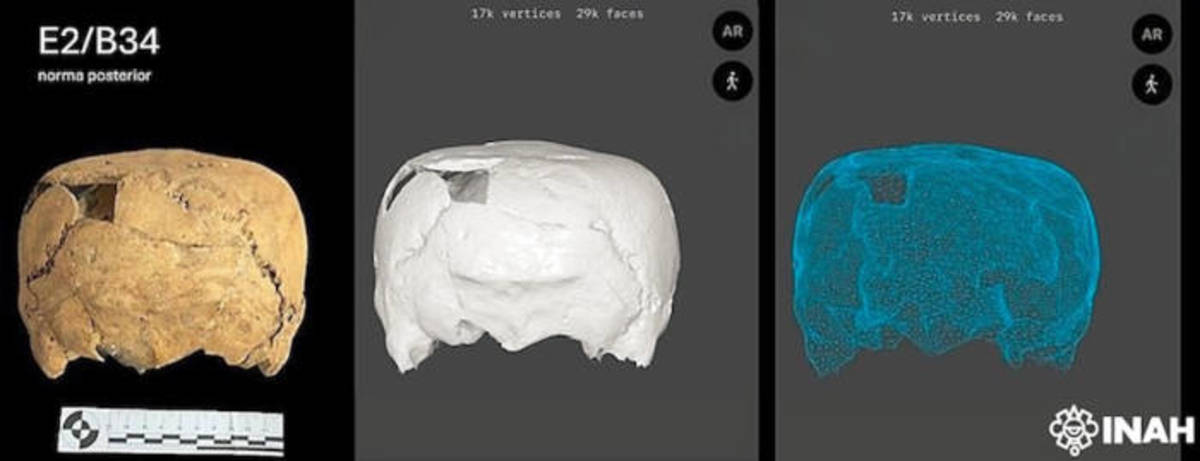
Similar Deformities Found in Far Away Regions
Such purposeful deformations have been identified at the El Zapotal site in Veracruz and in several former Mayan communities, but the level of deformation differs. The variations first suggested a possible migratory or cultural exchange between ancient citizens of El Zapotal and northern Huasteca populations. However, stable oxygen isotope analysis of collagen and bone bioapatite samples of another individual’s bones and teeth confirmed that they did not travel outside of the Sierra Madre Oriental region. “Therefore, the results discount a direct mobility relationship with groups from El Zapotal or further south,” González said. Therefore, the find indicates that practices were transmitted through cultural networks rather than migration.
Researchers believe that the cranial deformation practices were utilized by those with elevated positions within the society to differentiate themselves from other citizens. Often, they would wear headdresses or other adornments to accentuate the shape of their skulls. The new findings challenge previously held notions about ancient cultural networks, indicating that despite great distances similar practices made to communities far and wide.