There’s something about cooking an old family recipe in an heirloom cast iron pan that makes it taste just like the delicious meal that Grandma used to make. But if your treasured cast iron pan is looking a little worse for wear, don’t fret. We’ve got all the expert intel to help you restore your cast iron, as well as clean tons of other kitchen staples, like your fridge water dispenser, Keurig, and glass stove top. It’s possible to refresh that cast iron pan so it’s back in service for mouth-watering cornbread, fried chicken, banana fritters, or peach cobbler.
Here’s what you need to know about how to restore rusty cast iron cookware.
What Causes Cast Iron To Rust?
“Cast iron can rust when it’s left outside to the elements or if it wasn’t dried thoroughly after cleaning,” says Chris Wing, the cast iron restoration expert known as Cast Iron Chris. “Moisture causes the iron to oxidize, and that oxidation is what we see as rust.” While most metals can oxidize and form a protective layer of corrosion, when this layer is on cast iron, it looks orange and is called rust.
And rust is not uncommon on cast iron because “cast iron cookware is a porous metal and is susceptible to changes in oxygen, humidity, temperature, and moisture, causing oxidation,” says Seth Affoumado, founder of the The Skillet Doctor, who has over 20 years of experience restoring cast iron cookware. Rust can occur due to soaking the cast iron in water, improper storage, or if the seasoning layer becomes stripped.
When Can a Pan Be Restored and When Is It Beyond Repair?
“No matter how thick the buildup or how heavy the rust, cast iron cookware can almost always be restored,” says Wing. “That said, cracks are the true death sentence. Sometimes a pan looks fine until you remove the buildup, and suddenly a crack appears. Because cast iron expands and contracts with heat, that crack will continue to grow. Liquids can seep through, and in extreme cases a pan can literally break in half.”
You may also discover something called pitting under the rust. This is when small holes form on the surface of a cast iron pan due to excessive concentrated rust. Wing says: “Pitting can’t be ‘repaired,’ but it can still be cleaned and seasoned and is still fine to cook on.”
And don’t think about trying to smooth out the pits. Affoumado says that “pitting cannot be restored successfully because it sometimes is too deeply impressed into the metal. We do not recommend grinding to smooth it out. Grinding closes natural microscopic gaps in your cast iron and prevents oils from polymerizing and creating the natural non-stick property of cast iron cookware.”
Related: Think Your Shower Grout Is Ruined? These Cleaning Hacks Bust Through Mildew Stains Fast
What You Need to Remove Rust From Cast Iron
Depending on how much rust has formed on your pan, there are a few different supplies that can help you successfully remove rust from cast iron.
Light Rust Tools: Scrub-based
For light rust on cast iron, a scrub pad, steel wool, brush, scraper, coarse salt, cold water, and oil are supplies that will come in handy.
Medium Rust Tools: Vinegar-based
If the light rust tools don’t remove the rust, then the next method involves a 50-50 solution of water and white vinegar. It’s one of the easiest and best rust removers for cast iron. “This method is time consuming but does loosen up rust and makes re-seasoning your skillet a bit easier,” says Affoumado.
Heavy Rust Tools: Electrolysis-based
If there’s heavy rust on your cast iron cookware, then you may need to construct an electrolysis tank. This is not an entry-level DIY project, and we recommend watching a few videos on the process before attempting.
You’ll need a 20-gallon plastic container, water, carbon steel wire, clips, nuts, gloves, 12V battery charger, sodium carbonate, and steel sacrificial anodes. Affoumado says that an “electrolysis tank is the fastest and best method of rust and carbon removal on cast iron skillets, dutch ovens, or any iron materials such as tools, break pads, etc.”
Related: I Reviewed the Best Camping Cookware Available. These Sets Are Worth Their Weight
How to Remove Light to Moderate Rust From Cast Iron
If there’s a thin layer of rust, then it’s usually fairly easy to remove with the following method.
Step 1: Scrub rust with steel wool or a stiff brush.
“If you cleaned your skillet, left it out overnight, and woke up to light rust, it’s very superficial and should come right off,” says Wing. “Scrub with soap and a lighter-grade steel wool (or even the abrasive side of a sponge).”
Step 2: Rinse and repeat until bare metal appears.
After scrubbing the rust spot, rinse the area to check that all of the rust is gone. If it’s not, try repeating the scrubbing-and-rinsing steps a few more times until the metal surface appears where the rust was located.
Step 3: Soak in vinegar-water.
“If the rust doesn’t come off with some light elbow grease, use a 50/50 vinegar-water soak for about 45 minutes,” says Wing. “Scrub with a heavier grade steel wool. If rust remains, soak again for another 45 minutes. Repeat until the rust is gone. Do NOT soak overnight. Vinegar is acidic and can start damaging the iron if it’s left too long, hence the short soaks. Less is more here.”
Step 4: Baking soda paste method for spot treatment.
If there are stubborn areas, try a baking soda paste to help lift the rust from the cast iron. Mix two parts baking soda to one part water to make the paste. Apply the paste to the rust spot, and then let it sit for a few minutes before gently rubbing the paste into the spot.
Step 5: Rinse and dry completely to prevent flash rust.
Rinse the cast iron with water. However, as water is the creator of rust on cast iron, be vigilant about drying the pan. Affoumado warns: “You will experience “flash rust” in this process, which is ok.” Flash rust is a thin copper-colored layer of rust that’s powdery and can appear immediately after cleaning metal. If it appears, rub it out with a cloth.
Step 6: Re-season your cast iron.
“Once the rust is removed, definitely run the pan through three to four rounds of seasoning to build that protective layer back up,” says Wing. Follow the steps below to re-season your cast iron cookware to protect it from future rust.
Getty Images
How to Re-Season Cast Iron After Rust Removal
“Bare cast iron is gray, and it’s the seasoning—polymerized and carbonized oils—that gives it the classic black patina,” says Wing. “If you start to see gray spots, that’s your cue to give it a round or two of seasoning. And you can’t over-season cast iron, so there’s never harm in freshening it up. When I restore a piece of cast iron, I strip it completely down to bare iron. In that case, I always run my pieces through four rounds of seasoning.”
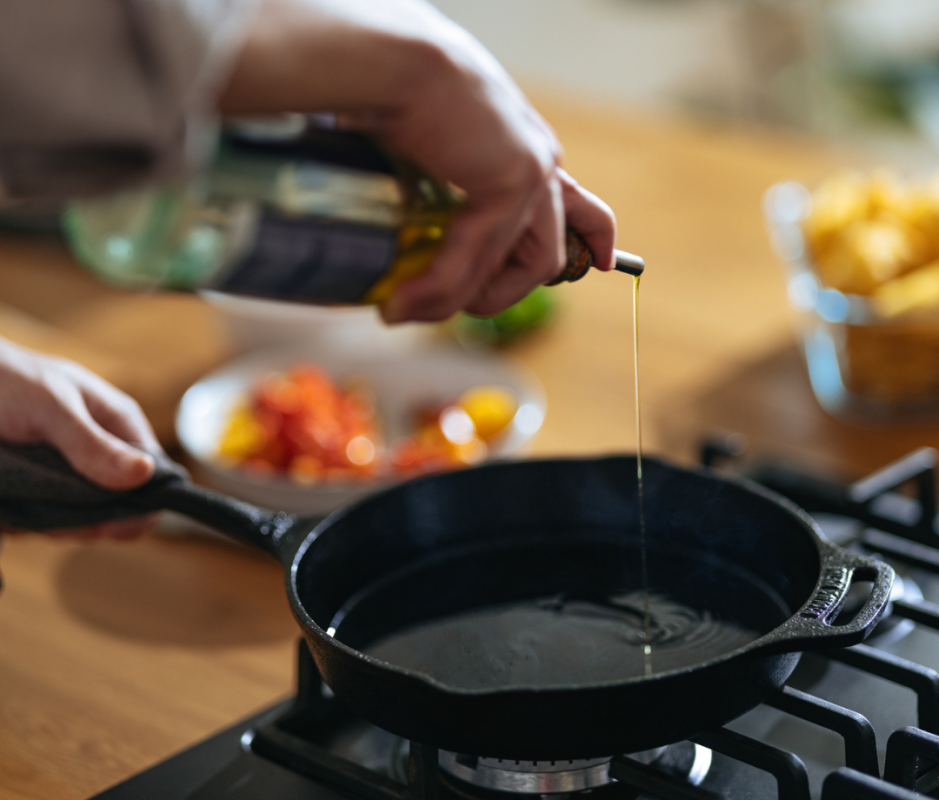
Step 1: Apply a thin layer of oil.
The type of oil used to season your cast iron cookware is important. The oil needs to have a high smoke point, so grapeseed and avocado are usually best. Vegetable oil can be used, but the seasoning isn’t as durable.
Using a cloth, wipe a very thin coat of oil all over the entire pan—inside, outside, and underneath.
Step 2: Bake in the oven for polymerization.
Then it’s time to bake the cast iron pan. Heat the oven to 200 degrees F and then place the pan upside-down on a cookie sheet inside the oven for 10 minutes to warm it. Then, increase the temperature to 400 degrees F. After an hour, turn off the oven. Do not remove the pan and leave the oven door closed so the pan can cool as the oven cools.
Step 3: Building multiple layers for long-term durability.
While one coat of seasoning is enough to keep rust at bay, most experts recommend at least two or three coats. So, after the pan is cooled, repeat steps 1 and 2 for additional coatings.
Maintenance Tips to Prevent Rust From Returning
With careful maintenance, you can prevent future rust forming on your cast iron cookware.
Practice correct cleaning methods.
Always dry cast iron after it encounters water and never soak your cast iron overnight or for long periods.
Store cast iron properly.
After using and cleaning your cast iron pan, apply a light coat of oil to the pan’s surface before storing it in a dry spot.
Re-season it regularly.
Periodically check the pan’s surface to make sure there are no issues with the coating. If there are any cracks in the coating, then it’s time to re-season the pan to prevent rust and pitting.
Related: Don’t Let Battery Corrosion Ruin Your Devices. Here’s How to Clean It Safely at Home
Common Mistakes to Avoid When Removing Rust From Cast Iron
Cast iron cookware is long-lasting and fairly easy to maintain, especially if you avoid some common mistakes. Most of these cast iron cleaning mistakes are made because they are fine for many other types of cookware.
Don’t over-soak in vinegar.
When trying to remove rust, don’t create more by over-soaking the pan in vinegar or water. Set a timer for 45 minutes so you don’t leave the pan in the solution too long.
Don’t use harsh chemicals or dishwashing detergents daily.
“The most efficient way to clean cast iron is the same way you’d clean any other cookware: soap and water. It’s a myth that you can’t use soap, as soap does not remove seasoning,” says Wing. “When cast iron is seasoned, the oil goes through polymerization: the fatty acids break down and their carbon chains cross-link into polymers. These are much closer to a plastic than the oil they started as, and soap can’t remove them. So most of the time soap and a sponge will do the trick. For more stubborn messes you can use a chainmail scrubber.”
However, Affoumado warns: “Chain mail removes seasoning and is harmful for newly restored vintage skillets. We use a bamboo cleaning brush which is compostable, abrasive and not invasive on your skillet finish.”
Don’t leave water on the skillet.
Water causes rust. “The most important part of cleaning is drying thoroughly,” says Wing. “I first towel-dry, then ‘heat dry’ on low heat for a few minutes to evaporate any leftover moisture.”
Don’t apply too much oil during seasoning.
If you apply too much oil to the surface of cast iron when seasoning it, the surface could become sticky and uneven. It could also be more likely to flake off during use. So, it’s best to apply thin layers of oil when seasoning cast iron.
FAQs About Rusty Cast Iron
Is a little rust dangerous?
“No. Rust is iron oxide and isn’t dangerous when ingested in small amounts,” says Wing. “It just doesn’t taste good and can eventually damage the pan.”
Can you use soap on cast iron?
Yes and no. Some experts are adamant about not using soap on cast iron. Others say that it’s ok to use some soap to quickly clean a cast iron pan. What’s most important is to not let water sit on the pan and to completely dry it after it has been wet.
Can cast iron break?
“Despite cast iron being heavy and hard, it’s actually quite brittle,” says Wing. “If your pan falls off the stove, there’s a good chance the handle snaps or the sidewalls crack. Cast iron is brittle because of its high carbon content and crystalline structure, great for cooking, not so great for impact.”
Should I slowly heat up cast iron?
“Cast iron also hates drastic temperature changes,” says Wing. “Rapid heating (especially on electric or induction stoves) or running cold water over a piping hot pan can create thermal shock. That can warp or even crack a pan.”
“People have literally split pans in half from heating them too quickly. So heat your pan slowly. If you need high heat (like for searing a steak) warm it over medium-low heat first for a few minutes before cranking it up.”
How often should you season your skillet?
The frequency of seasoning a cast iron skillet depends on how often you use the skillet and if you notice food sticking to the surface. If food is sticking, it’s time to re-season the skillet. For regular upkeep on a skillet that’s used typically, consider seasoning it a few times a year.