If your feelings about turbulence are more “this plane is going down!” than “woo, it’s like a rollercoaster,” you might want to listen up. Each year, the turbulence tracking website Turbli releases lists of the most turbulent airports and flight paths, and its 2025 rankings reveal one U.S. airport in particular that turbulence-phobes should avoid: Denver International Airport, which showed up on half of the 10 most turbulent flight paths in the U.S. to take the top spot as the most turbulent airport in North America.
How the Rankings Are Created
To create its list of most turbulent flight paths and airports, Turbli starts by looking at turbulence forecast data from NOAA and the UK Met Office. Snapshots of the forecast are taken every six hours and combined (at first monthly, and then yearly) to create the statistics. Turbulence is measured using something called the eddy dissipation rate (edr), which, per the website, “is an aircraft independent unit that represents the speed at which turbulent structures break down and dissipate their energy into heat.” Turbli then breaks it down into a scale:
- Light: EDR 0-20. Smooth flight conditions
- Moderate: EDR 20-40. Difficulty in walking and food services
- Moderate–Severe: EDR 40-60. Strong strains against seat belts
- Severe: EDR 60-80. Violent and sudden changes in altitude
- Extreme: EDR 80-100. Aircraft is practically impossible to control
Included in their rankings are the 550 largest airports in the world, as well as some additions to make sure that at least one airport from every country is represented. When looking at routes, according to the website, “We only consider routes between the selected large airports and covered by at least one airline, resulting in about 10,000 analyzed routes per year. … Every month, the average turbulence of each route is calculated over a random sample of up to 20 flight tracks taken from our internal tracking database.”
The Most Turbulent Airports in North America
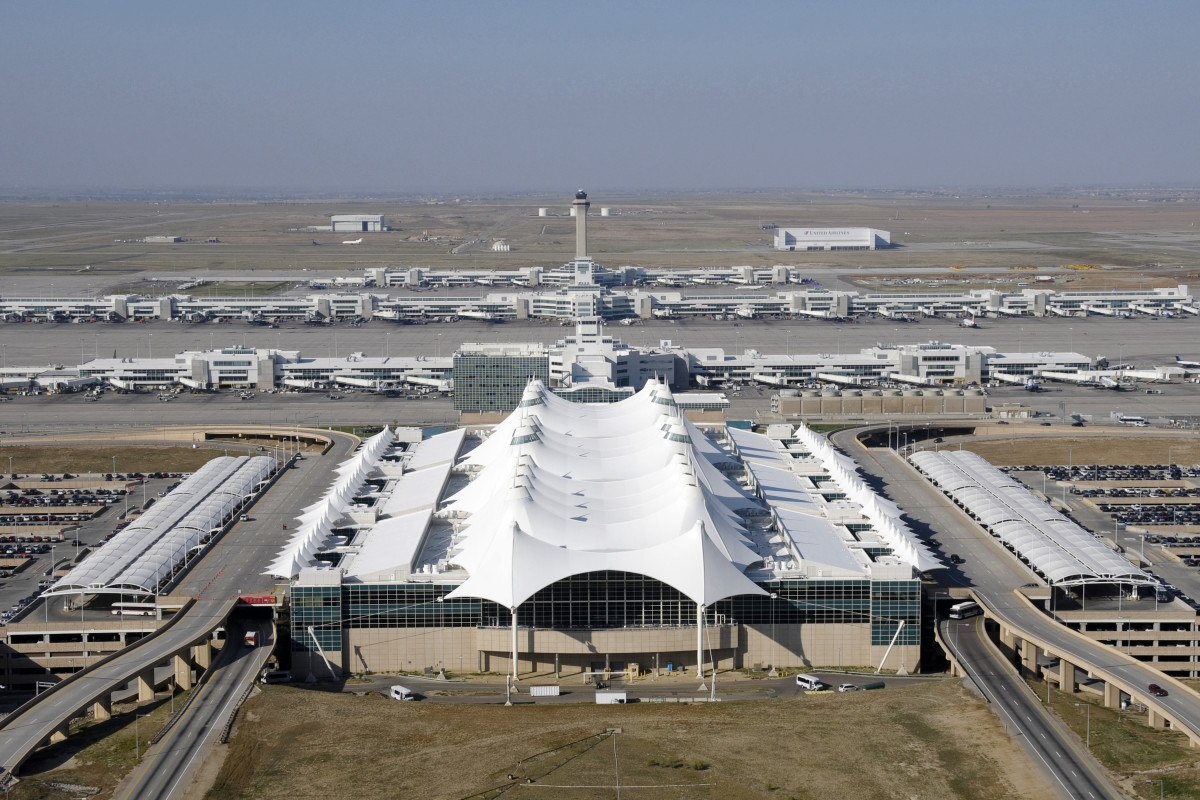
Denver International Airport topped Turbli’s list of most turbulent airports, with an average turbulence of 17.911. (The airport—which is the subject of some bizarre conspiracy theories—also made Turbli’s list of airports with the highest average turbulence, coming in at number seven.) It’s followed by Montana’s Bozeman Yellowstone International Airport, which had an average turbulence of 17.556. New Mexico’s Albuquerque International Sunport is number three with an average turbulence of 16.62.
|
Ranking |
Airport |
Average Turbulence (edr) |
|
1 |
Denver |
17.911 |
|
2 |
Bozeman |
17.556 |
|
3 |
Albuquerque |
16.62 |
|
4 |
Salt Lake City |
16.56 |
|
5 |
Jackson |
16.391 |
|
6 |
Vancouver |
16.159 |
|
7 |
Las Vegas |
15.873 |
|
8 |
Seattle |
15.779 |
|
9 |
Reno |
15.591 |
|
10 |
Boise |
15.475 |
The Most Turbulent Flight Paths in North America
The roughly 405-mile trip from Denver International Airport to Jackson Hole International Airport in Wyoming took the top spot for the most turbulent flight routes in North America, with an average turbulence of 18.18. It was followed by Albuquerque to Denver (18.18, with a shorter distance of around 349 miles) and Jackson to Salt Lake City International Airport (17.676). Mountains surround these routes, which could lead to mountain waves, in which “large-scale winds are perpendicular to the mountain ranges,” sometimes leading to “very strong wind gusts in a narrow area along the foothills” and “strong turbulence which adversely affects aviation,” according to the National Weather Service.
|
Ranking |
Route |
Average Turbulence (edr) |
|
1 |
Denver (DEN) – Jackson (JAC) |
18.8 |
|
2 |
Albuquerque (ABQ) – Denver (DEN) |
18.8 |
|
3 |
Jackson (JAC) – Salt Lake City (SLC) |
17.676 |
|
4 |
Denver (DEN) – Salt Lake City (SLC) |
17.538 |
|
5 |
Bozeman (BZN) – Denver (DEN) |
17.221 |
|
6 |
Boise (BOI) – Bozeman (BZN) |
16.519 |
|
7 |
Bozeman (BZN) – Salt Lake City (SLC) |
16.486 |
|
8 |
Albuquerque (ABQ) – Salt Lake City (SLC) |
16.17 |
|
9 |
Denver (DEN) – Las Vegas (LAS) |
16.128 |
|
10 |
Las Vegas (LAS) – Salt Lake City (SLC) |
16.109 |
Airports With the Highest Average Turbulence
According to Turbli’s analysis, Arturo Merino Benítez International Airport in Santiago, Chile, is the most turbulent airport in the world, with an average turbulence of 21.446. Coming in at number 2 is El Plumerillo International Airport in Mendoza, Argentina, at 21.174, followed by Martín Miguel de Güemes International Airport in Salta, Argentina, at 20.701.
|
Ranking |
Airport |
Average Turbulence (edr) |
|
1 |
Santiago |
21.446 |
|
2 |
Mendoza |
21.174 |
|
3 |
Salta |
20.701 |
|
4 |
Xining |
19.221 |
|
5 |
Lanzhou |
18.247 |
|
6 |
Kathmandu |
18.01 |
|
7 |
Denver |
17.911 |
|
8 |
Lhasa |
17.687 |
|
9 |
Bozeman |
17.556 |
|
10 |
Kabul |
17.387 |
Is Turbulence Getting Worse?
In a word, yes—according to one study published in 2023, the skies are 55 percent more turbulent than they were in 1979. It pinpointed climate change as the cause of bumpier flights.
It might feel scary, but turbulence is generally nothing to worry about: As Travel + Leisure points out, modern planes are built to withstand it and other factors present while we fly, and pilots are better prepared as well. “Our ability to forecast the location, timing, and severity of turbulence has also advanced,” Bill Duncan, the associate director of meteorology at The Weather Company, told the publication. “Airlines and pilots can now use these predictions to choose smoother routes or prepare passengers and crew for potentially turbulent conditions.”
For the full list of rankings from around the world, visit Turbli’s website.