Men’s Journal aims to feature only the best products and services. If you buy something via one of our links, we may earn a commission.
Back in the middle of last year, I first experienced BFGoodrich’s new KO3 tires on an early production Ford Ranger Raptor. Blasting around in such a hard-charging pickup quickly revealed how much the new tires improve on the outgoing—and outdated—KO2, so when BFG offered to send me a set for long-term review on my own rig, I immediately said yes.
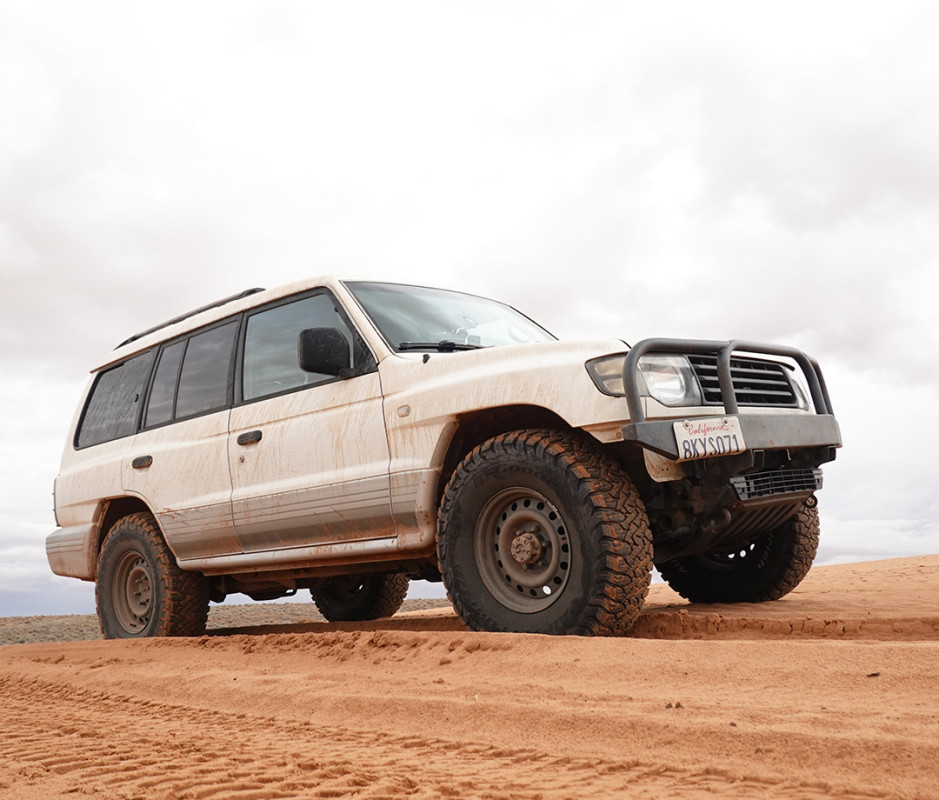
My truck probably represents more of a typical use case than the Ranger Raptor, a mildly built 1998 Mitsubishi Montero that weighs in the ballpark of 5,000 pounds thanks to a set of thick stainless steel engine and transmission skid plates, Toyota FJ Cruiser “steelie” wheels, and a sleeping platform built inside for budget-style overlanding. Due to early tire size availability, the KO3s arrived in a slightly larger diameter and width than I wanted. Luckily, I recently re-geared my front and rear diffs to 4.90s versus the stock 4.27s, which made stepping up to 33-inch tires a lot more appealing.
Michael Teo Van Runkle
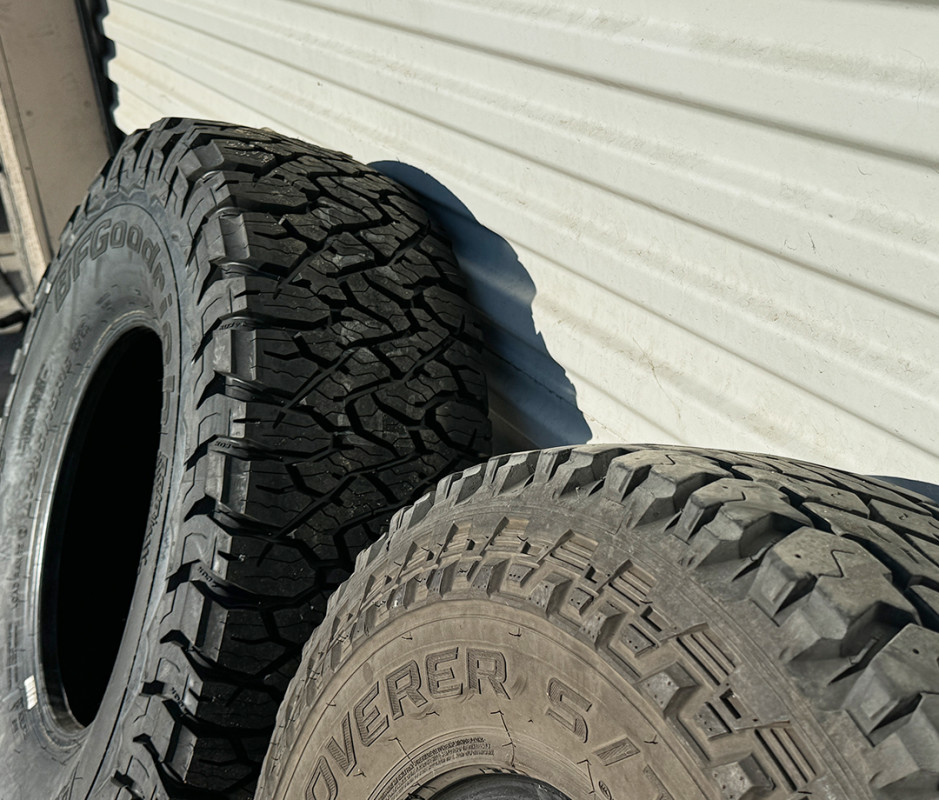
Specifically, the KO3s came in size 285/75R16 and replaced a set of superb Cooper Discoverer S/T Maxx tires that I trusted completely after more than 40,000 reliable miles—and that had plenty of tread left to go. But the Coopers weighed a lot, made plenty of noise, and come with a hefty price tag, too. By contrast, the KO3s as a small 33-incher (32.8 inches by 11.2 inches, to be precise) weigh a respectable 60.3 pounds each, and even my first impressions after mounting the set confirmed what I initially experienced on the Raptor.
I spent the next year racking up almost exactly 10,000 miles, made up of mostly city and highway miles as usual, but also plenty of off-road testing including a serious overlanding adventure this fall that involved the most hardcore rock-crawling this Montero has ever done (and probably can do), some mudding, some snow, and even a few hours of 75-plus mile-per-hour rally driving on an awesome graded road in the middle of nowhere Utah. Regardless of the conditions, the KO3s set a new standard for comfort, quiet, compliance, and performance in every possible condition. Beyond a reasonable doubt, I can say these are the new king of off-roading tires.
Related: Why Tires and Wheels May Be the Most Important Part of Off-Roading
What It Is
Simply put, tires are the most important part of any vehicle, on or off road. For off-road tires, it’s critical to understand the difference between all-terrain (A/T) and mud-terrain (M/T) options, and also the increasingly popular rugged-terrain (R/T) designation. The new KO3 pushes the boundaries of the A/T segment, as did the KO2 before it. These tires serve for the serious enthusiast, but also come in tamer sizes for rigs less capable than a full-on Jeep rock crawler.
Michael Teo Van Runkle
BFGoodrich waited a full decade to replace the popular KO2 tire, for a much longer generational timeframe than most other tiremakers. This allowed for plenty of development time to improve on everything the undeniably rugged, yet somewhat outdated KO2 struggles to do.
My set of K03s arrived in LT-metric 285/75R16: which translates to 285 millimeters wide, with a 75 aspect ratio, for 16-inch wheels (and LT means “light truck” versus the P-metric designation for passenger vehicles). They’re also rated with the 3 Peak Mountain Snowflake (3PMS), a somewhat silly winter testing regimen that nonetheless does indicate that the rubber compound performs well in cold weather.
BFGoodrich KO3 Tires Overall Impressions
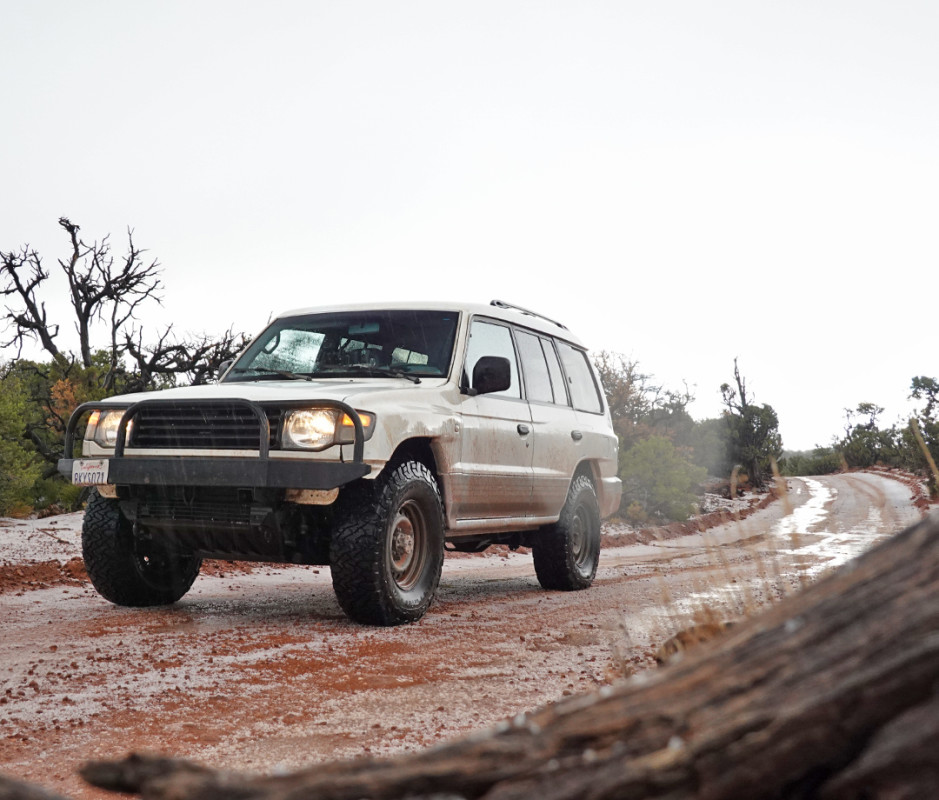
Over the course of a full year with the KO3s, I tested nearly every possible condition. But the first thing I noticed after mounting the tires was how good they looked when fully inflated, with a beefy and slightly more aggressive three-dimensional design for the treads and blocks. The Coopers also looked macho, and because the KO3s measured almost one inch taller and two inches wider, they weighed more—for the same size tire, by contrast, the BFGs actually weigh about five pounds less.
Michael Teo Van Runkle
As much as off-roaders love off-road tires, the truth remains that 99 percent of driving for most people happens on public roads. Here, the specs rear up almost more, and the updated KO3 truly reigns supreme. Initially, I noticed a much more cushy ride quality than for KO2s, and especially the stiff and heavy Coopers. More in keeping with other A/T tires of this generation—like the Toyo Open Country A/T III, Falken Wildpeak A/T, or Yokohama Geolandar AT4—whereas the KO2 trended nearer to the ride quality of an M/T tire. Despite stepping up in size, I noticed minimal performance decrease from my admittedly underpowered Montero due to the efficiency of rotational mass.
At city speeds and on freeways alike, the KO3 sidewall also felt more compliant at my usual 38 psi pressure. Then I went off-road. Repeatedly. First on some short stints up graded fire roads, the usual life exploring the desert around Los Angeles. But more recently, after about 8,000 miles of normal driving, I then put the KO3s through a real torture test over the course of five days off-roading in Utah.
The first day, I aired up to 44 psi for better fuel economy on the long drive from L.A. to Southeastern Utah, then deflated down to 22 psi when I reached the first trail. At lower pressure, as I ripped up a winding mountain ride rally-car style, the improved smoothness blew my mind. Of course, the Montero was not really made for this, and felt a little tippy. It also can’t drift under power, even in two-wheel drive. But the KO3s also provided so much traction that I felt the truck starting to lean a bit too much for safety before the tires lost any grip and started sliding. Impressive, to say the least.
Michael Teo Van Runkle
The next day I took the Montero on the most serious rock crawling imaginable—more than expected from the OnX trail rating, honestly, so much so that if I’d known, I probably would have turned around. Suffice to say, I wound up super glad to have the KO3s. I could have deflated my tires lower, but never felt a lack of grip on the rocks. And really, with 16-inch wheels and the more compliant, comfortable sidewalls, I also wanted to avoid de-beading a tire off the rim.
Perhaps the most important aspect of rock crawling with the KO3s only occurred to me later. Namely, that I never needed to spin up the tires to build heat and create traction, something the drier and more rigid KO2s often required. Instead, the rubber felt ready all the time, absorbing chunky sections and sticking to rockface aspects shockingly well. Since I never needed to worry about my tires, the KO3s let me focus more on when ground clearance and line choice and my truck’s departure angle became critically important.
The next day we covered more distance on a trail slightly more technical than a graded fire road, full of sharp rocks and occasional blind corners. But we also needed to cover a ton of distance, which meant going faster than I might have otherwise. By keeping my tire tread on the riskier rocks while keeping up the pace, the KO3s handled a long day in the saddle with ease—afterward, I tucked my head under the wheel well to check for any wear, and saw very minimal rubber damage.
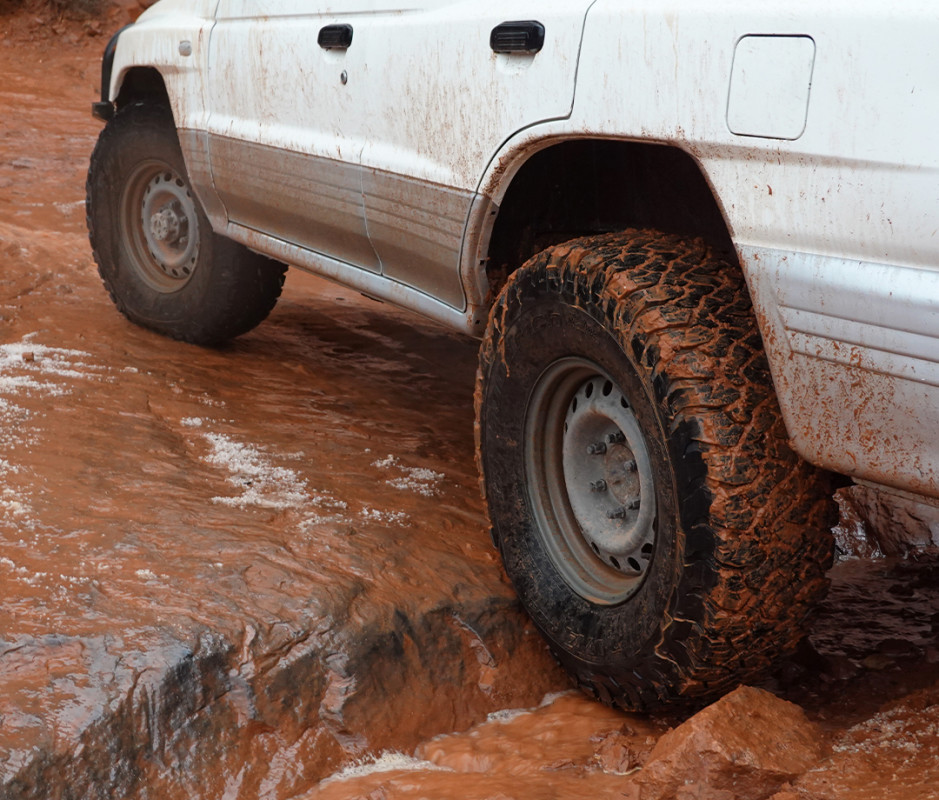
That night the weather hit. It rained and hailed, and I woke up to the crash of thunder and lightning wondering how the KO3s might handle tacky Utah mud the next day. No problem, as the desert sand absorbed plenty of moisture once the sun came up the next morning. But a second round of storm clouds rolled in an hour or so after we packed up and hit the trail again, which threatened flash flooding down some slot canyons and washes we needed to cross to get to the next campsite.
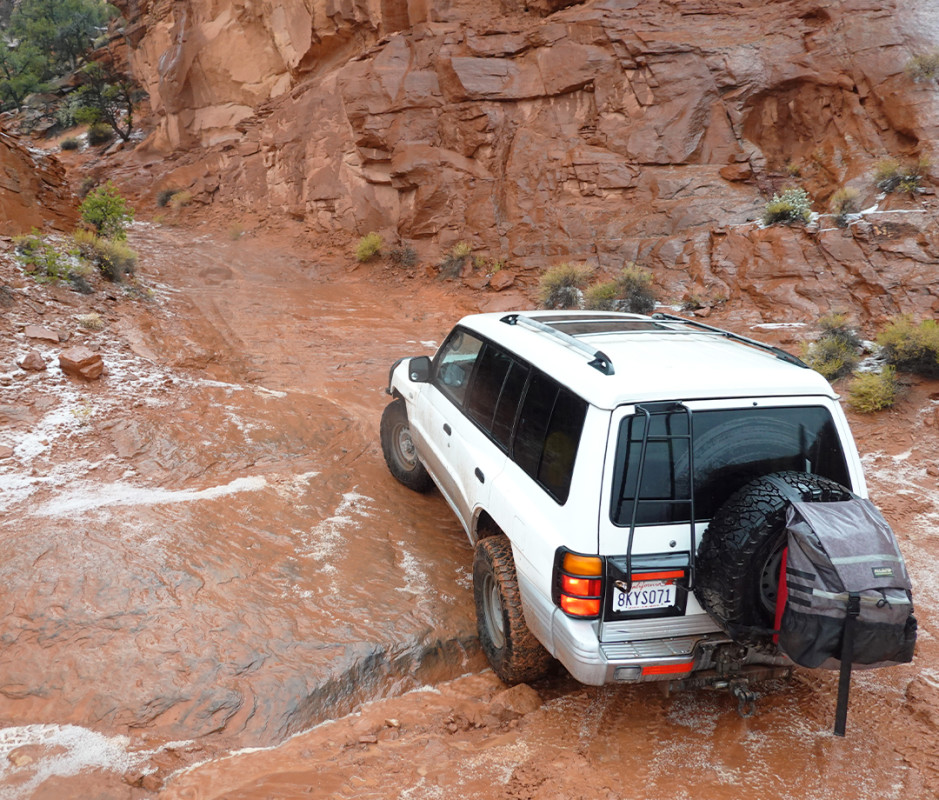
The only safe option seemed to be to climb a gnarly ridge rather than tracing down toward the flow of water. Again, sharp rocks littered the trail, but this time around any dirt now transformed into slick mud and all the rock faces turned into mini waterfalls. Some of the slickest muddy parts led to some slip and slide, and I wound up in deeper ruts that I hoped to avoid. Luckily, the previous day’s durability test leant me the confidence that my tires could handle the challenge, even when the rain turned to snow and hail further up the ridge. Again, I started to get a little nervous but the KO3s absolutely ate the worst of everything that Mother Nature cooked up.
Michael Teo Van Runkle
Only a triple-locked Gladiator on 37-inch tires and my Montero completed the climb. The rest of our group had to turn around, wait out the storm, and then brave some water crossings at a sketchy time immediately post-rain. To loop around and meet up again, the Gladiator and I needed to hustle along stretches of 75-plus mile-per-hour graded dirt out to the horizon, the fastest I’ve ever driven this truck. Cruising over rough washboards and through high-speed bends, the tires served as my first suspension component. Again, even in some wet and damp sections plus a few unexpected sand dunes, grip outweighed body lean and I needed to slow down occasionally to avoid too much tilt rather than four-wheel sliding through turns.
After a cold night camping at Swing Arm City, I packed up early and hit the road for another 650-mile blast back to L.A. at top speed. Despite the previous four days’ shellacking, the KO3s still exhibited minimal tire noise, though when I got home, I noticed a bit of new wear on the tire shoulders after so much higher speed racing, rock crawling, and about 1,500 total freeway miles. I rotated the tires in an X pattern, and believe they’re good for many more hardcore trips over the course of what I suspect should be a long service lifetime.
Key Features
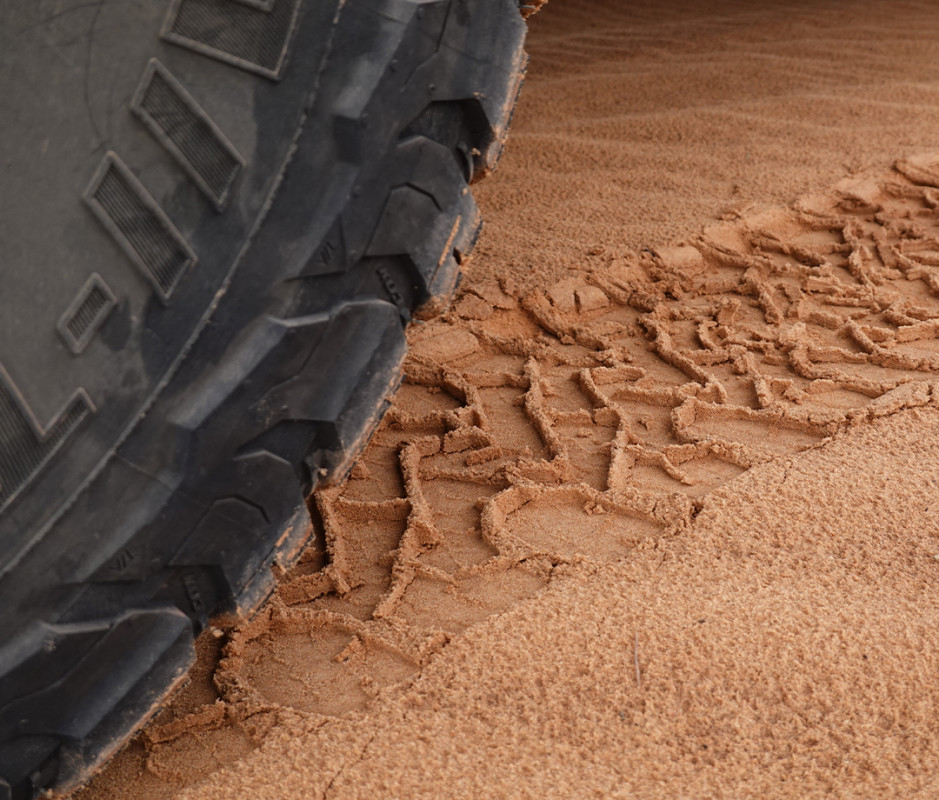
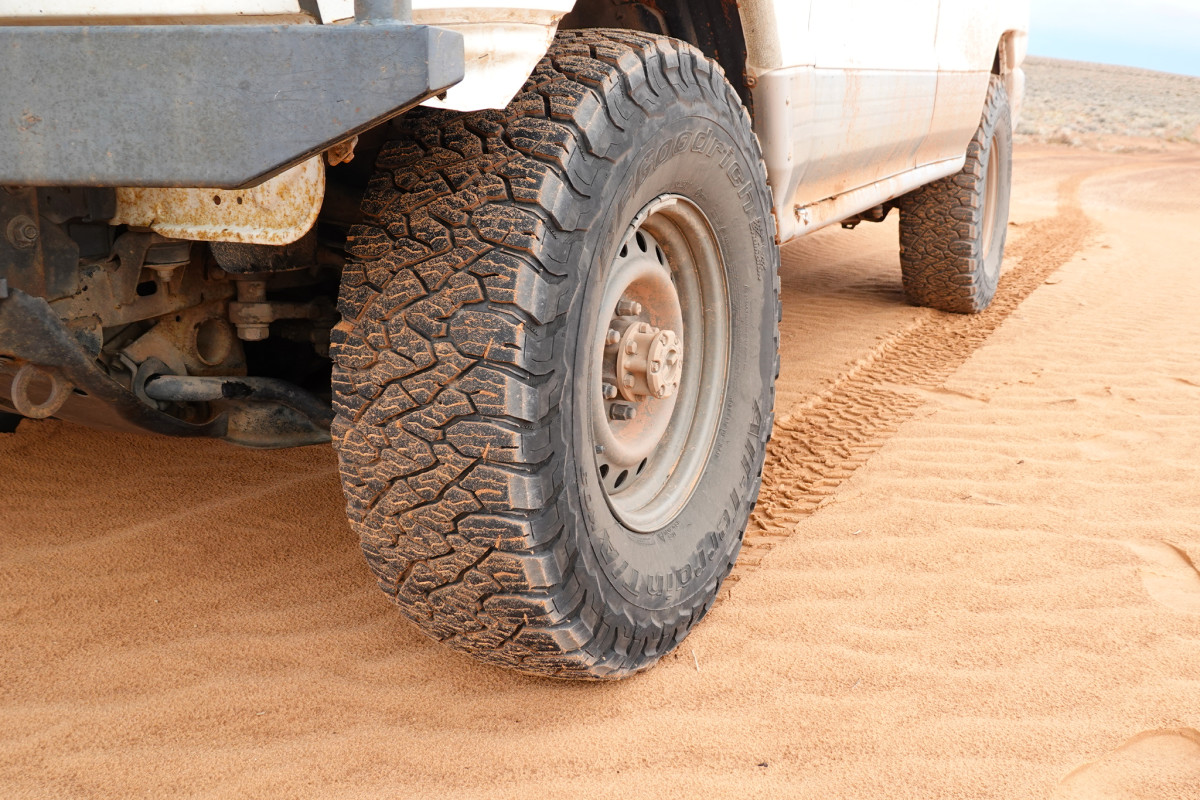
The KO3s tread pattern reveals much of BFG’s priorities for the new tire. The blocks sit closer together, denser at the center of the tread, while the edges spread out more to prevent rock throw while improving both aesthetics and mud performance. Deep sipes aid with water evacuation and mud flinging flex bars further help when aired down. Performance doesn’t come at the cost of reduced durability, though, unlike for example, with road racing tires for track days.
Michael Teo Van Runkle
BFG claims that the KO3s improve by 15 percent in wear resistance with 6 percent rolling resistance gained versus the outgoing KO2—including 20 percent better wear while driving on gravel. My experience certainly suggests these impressive figures might play out in reality. But the sidewall rubber comes from the full-on KR3 race tire, which adds resilience against slashes even as the KO3 feels more plush most of the time.
Reading the sidewalls shows what sizes and load ranges the KO3 comes in: load ranges C, D, E, and F across LT and P-metric sizes for wheels from 15 to 22 inches in diameter. All come with a 50,000-mile warranty.
Pros
- Incredible grip in wet and snow, on rocks, in sand, low-speed crawling, and high-speed ripping
- Docile demeanor on road, not too noisy or clunky
- Looks perfectly macho, clean or dirty
- Impressive longevity after 10,000 miles of abuse
Cons
- Not the cheapest tire
- Still not quite as silent as any typical road tire
- Other tire manufacturers offer longer warranties
Final Verdict
Michael Teo Van Runkle
A full year and just over 10,000 miles later, I can confidently recommend the KO3 to anyone debating a purchase versus anything else on the market. I’ve driven just about every off-road tire imaginable, and these are the best all-around all-terrains out right now, by a wide margin. Personally, my size choices were limited by BFG’s launch schedule for the KO3. If given the choice, I might go with a slightly narrower tire to save some rotational mass, keep that vintage “pizza cutter” look, and reduce a bit of turning effort that came about simply because the tires have so much grip.
Really, the question does come down to pricing. My tires run $303.99 right now on Tire Rack, which adds up quickly for a set of five including a spare. That’s not an insane premium versus most competitors, though, and for the same size as my old Coopers, the KO3s actually cost about $20 less per tire. For this level of performance, the decision seems easy. Especially if BFG allows for any seasonal discounts or rebates, all the better. I will likely swap on a new set of tires to test from another company soon, but I truly almost want to just keep the BFGoodrich KO3s forever. They’re just that good.
Why You Should Trust Me
As a longtime automotive journalist, I drive between five to seven different vehicles a week, all year long. But I got into tire technology in a big way after getting my 996-generation Porsche 911 Carrera 4 stuck in snow years ago, despite having all-season tires and all-wheel drive. The next year, ironically in the same place with the same passenger riding along—but with winter tires equipped—I drove the same car through an almost identical storm without a single moment of slip. Now I always focus on the tires, whether I’m driving Hyundais or Bugattis, in town or while doing anything from tracking Lamborghinis to rock crawling at the King of the Hammers race course or pre-running the Baja 1000. So I can prove firsthand that tires are the single most important part of any vehicle.
Related: Is the New 2024 Toyota Land Cruiser a Blast From the Past?