They laugh at us! I’m talking about the figures sitting on stands arranged on Goya’s esplanade in Madrid. The hilarity that stirs them is so great that some who are about to fall continue laughing. The title of Thirteen laughing at each other points out that the protagonists of this sculptural series are actually responding to a humor that is foreign to us.
Juan Muñoz, art stories
Prado Museum. Madrid. Commissioner: Vicente Todolí. Until March 8
This is one of the best-known works of the Madrid artist Juan Muñoz (Madrid, 1953-Ibiza, 2001), who stars in an exhibition at the Prado Museum, in dialogue with the historic art gallery.
Muñoz was one of the artists most notable during the eighties and ninetiesand his early death in 2001 does not nullify this validity. In his work he often borrowed elements from the great tradition of art history, with particular reference to Velázquez and Goya.
Curator Vicente Todolí, former director of the Tate Modern in London, has combined his work with this particular family tree. Todolí says he has asked himself a question: What would Juan Muñoz do in the Prado?
The exhibition is distributed in the Jerónimos Cloister and in the Villanueva building, where it converses with the permanent collection. In the Sala de las Meninas, Sara with pool table (1996), a woman with bone dysplasia contemplates images of herself on a light tablewhile it seems to be observed by the characters in the famous painting by Velázquez, establishing an implicit relationship with Maribárbola.
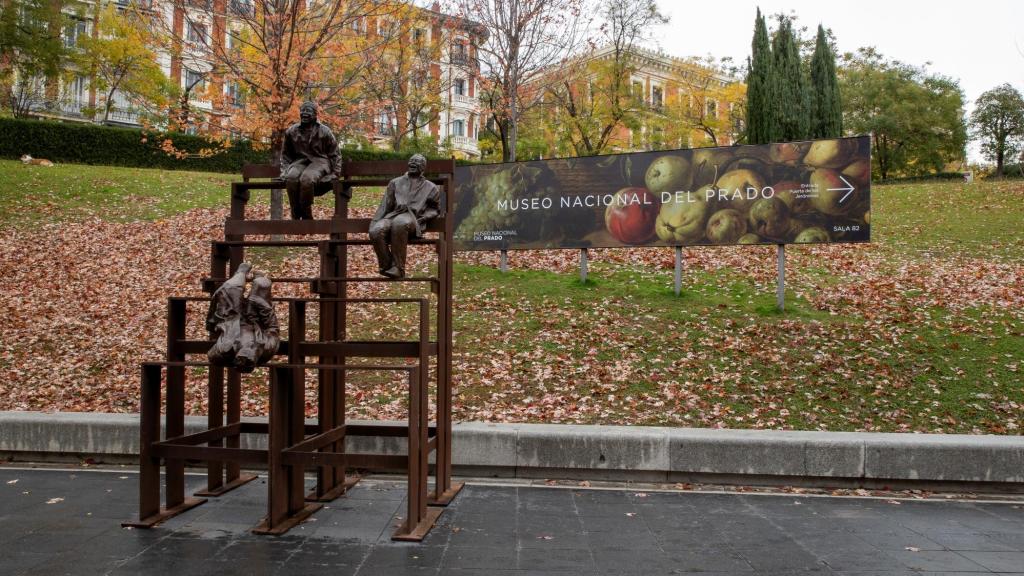
One of the works in the exhibition ‘Juan Muñoz. Art Stories’, on the esplanade outside the museum. Photo: National Prado Museum
In the Central Gallery, the balloon figures of Conversation scene III (2001) force visitors to go around them to continue their journey. From the staircase that goes to Goya’s black paintings we see two acrobatic figures suspended from the ceiling by a rope.
One is holding on to one leg, while the other grabs the rope with its teeth. The feeling of fragility, the frozen movement, the world of magic and existential anguish They pose life as a very precarious game of balance.
Although Juan Muñoz was one of those responsible for the return of figurative sculpture to contemporary art, his works also incorporate the legacy of the expanded arts of the seventiesoften including a spatiality that refers to minimalism.
Since the mid-eighties, Muñoz’s universe introduced its so-called “optical floors”, whose geometry draws infinite spaces and visual illusions. Not in vain did the creator love the work of the architects Bernini and Borromini, who tried to expand the space with trompe-l’oeil and optical games.
He said he believed that “the great artists of the Baroque were asked the same as modern artists: build a fictional placeto make the world bigger than it is.”
Muñoz often builds fragments of theaters. In The pointer (1988), the figure of George, a man with bone dysplasia, takes the place of someone who reminds viewers of the text of a work. However, this is before an empty stage where there is only a silent drum.
He loved the work of Bernini and Borromini, who expanded the space with trompe l’oeil and optical games
As in life, no one tells us what the script is. If the world is a theater, it is a theater of the absurd. The scene also makes one think of the filmmaker David Lynch, who apparently was influenced by the Madrid artist. Muñoz stated that he wanted to “create a memory housethe mind that is never seen but is always there.”
Along the route we contemplate a catalog of self-absorbed characters who participate in scenes frozen in time and possess an unfathomable mystery. Asian figures whose repeated face is taken from the mold of a single bust Art Nouveau. Acrobats, whose features correspond to those of a sculpture of an Egyptian king from the 4th century BC whose nose was broken to remove his spiritual power.
Juan Muñoz: ‘Five seated figures’, 1996. Photo: Museo del Prado / Luis Asín
The repeated presence of two people with bone dysplasia, Jorge (baptized as George in the artist’s work) and Sara, served as a model for Muñoz. to all of them a resounding silence surrounds thema muffled noise, made of laughter or screams that we cannot hear and complicities between the sculptures that never include the viewer either in their gaze or in their gesture.
Like ghosts, they seem to inhabit another universe parallel to our own. And despite being visible, His world is impenetrable to us. Legend has it that one of his pieces that is part of the collection of the Reina Sofía Museum was one of the objects that Ataúlfo, a supposed ghost that inhabits the building, moved at night.
The very notion of memory has something ghostly: it is made of the pasts that inhabit our present. The stands with which the exhibition began refer us to time spatialization projects such as the Theater of Memory by the Italian humanist Giulio Camillo, who in the 16th century conceived a fictitious architecture to classify all the knowledge available at the time.
We can see these affinities in the artist’s library, a part of which has come to the exhibition as a series of footnotes. However, following the trail of references does not lead us to resolve the indecipherable ambiguity of the sculptures by Muñoz, whose meaning lies rather in helping us accept that the punctuation mark of our existence will always be the question.
The post sculptures that look at the paintings of the Prado Museum appeared first on Veritas News.