After four intense years of work in the direction of MACBA, trying to ensure that other stories, knowledge and waysuntil now little visible, to understand the world, enter through the door, Elvira Dyangani Ose (Córdoba, 1974) has achieved it.
Today the museum celebrates its 30th year with several fascinating projects: an exhibition on the Pan-African imaginary, a major retrospective of Aurèlia Muñoz, the presentation of the new collection and the expansion of MACBA outside its walls.
Its programming advances a new museology that looks to the future. An art center that, beyond the artistic object, also addresses the need to “be together.”
Ask. How has MACBA changed since its founding in 1995?
R. Well, a lot! On the one hand, has attended to what was called the “new institutionality”which tried to break with the image of the 19th century museum and which had in its imagination a colonial apparatus structure. This was undone through education and remade as a public and critical space. The idea that the museum is no longer object-oriented, but rather a space in which experiences happen, has changed.
P. What is your imagined museum like?
R. One that does not attend to a single narrative, to Western certainty as canon, but rather joins more plural knowledge that existed prior to him.
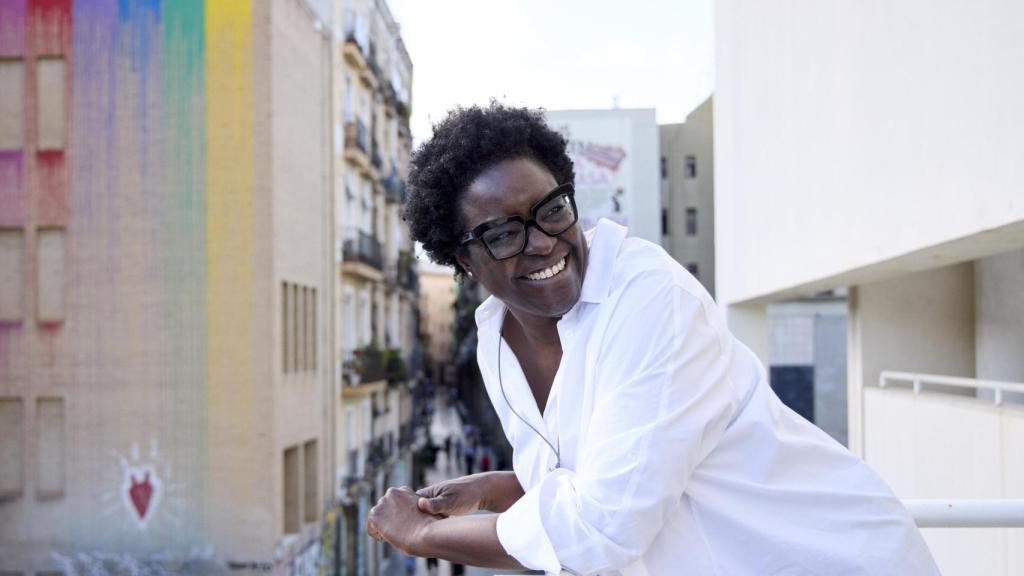
Portrait of Elvira Dyangani Ose. Photo: Toni Mateu
P. And the art of the future?
R. As viewers, what we seek is to be absolutely amazed. Not only that they tell us the story, but that they make us feel it. There is a lot of talk about how the absurd content in images of the world limits us and it desensitizes us. What we want is for art to give us back that sensitivity, as a ritual, as experimentation beyond the oculocentric.
P. Is that why one of the 30th anniversary projects is to move the museum out of the building?
R. We defend public quality: the museum is a right. And we will take it to other imaginaries, to produce a museum outside the museum. We will be in 25 spaces linked to the Generalitat: a hairdresser, a dentist, a bus stop or a mayor’s office.
P. In a hypervisual era, do you think about the devaluation of images when you program?
R. Of course. There’s something about the way we work that has to do with being together. There is a tendency – and an example is immersive spaces – to go beyond screens: we want an experience that incorporates all of our physicality. We must build spaces to inhabit beyond the contemplation of an object.
P. One of the featured exhibits of the 30th anniversary is on Pan-Africanism. Do you have anything manifest?
R. Yes, it is a manifesto and a way of understanding the world beyond the Western world. Something that seems very interesting to me is that Pan-Africanism looks at Spain at the end of the Second Republicis interested in this idea of progress, of the emancipation of women, of reformulation of a new world, and that helps us understand why an exhibition like this makes sense at this time, not only in Barcelona, but in the world.

Itziar Okariz: ‘Pissing in public or private spaces’, 2000 – 200. Photo: Col·lecció MACBA. MACBA Foundation © Itziar Okariz
P. Why is it current?
R. The struggle raised, not only by black radicalism but also by Marxism, sees the opportunity to fight for a new world and is in force due to the threat of the extreme right. The use of culture as a throwing weapon encouraged them – young Africans and Martinicans from the diaspora in Paris – to create this project in legitimate defense. The experimental democracy that was being experienced in Spain was a symbol of the future and utopia. And we must recognize that story as our own, since it belongs to all of us.
P. How are these ideas formalized in the exhibition?
R. The art reflects it very well and It is the first time that African art has been studied in these terms. The exhibition does not try to give a complete idea, but rather brings elements that will serve to develop new lines of work. We are also affected by Latin American aspects such as quilombismo, the protest work of Wifredo Lam, the Havana Biennial project, Brazilian anthropophagy… There are many connections.
P. In the new collection, very different artists coexist, such as Tàpies with Josefa Tolrà, in a fascinating rewriting of art history.
R. There is a key position, which is the dehierarchization of categories. I find it very beautiful that the work of Baya, who is an Algerian surrealist artist who had important links with the avant-garde, is very similar to that of Tolrà. That imaginary in which the avant-garde sifted certain forms of art has already been diluted. It was all art, it was just categorized according to certain interests.
Josep Uclés: ‘Composició’, 1985. Foto: Col·lecció MACBA. Dipòsit de la Generalitat de Catalunya. Col·lecció Nacional d’Art. Antiga Col·lecció Salvador Riera
P. Como experta en descolonización y museos, ¿cómo cree que debe hacerse este proceso, por ejemplo, con el patrimonio traído de otros países, como México, que pertenecieron en su día a España?
R. No conozco el proceso de México en profundidad. Lo primero es que los museos mantengan su independencia. Lo segundo, que las administraciones públicas los acompañen, y, tercero, es importante que se revisen las políticas culturales alrededor de ciertas instituciones. Sin ese tipo de sensibilidad y sofisticación será difícil que los museos progresen.
P. Habrá que valorar cada museo en su contexto.
R. En su Discurso sobre el colonialismo, Aimé Césaire decía que Europa era indefendible en términos de sumisión colonizadora emancipadora. Tenemos que reconocer cuál es el rol que tienen las instituciones culturales en relación con los objetos que contienen y con las historias de las que esos objetos son deudores. El ejercicio descolonizador tiene que emanciparse de los que descolonizan.
P. ¿Cómo es dirigir un museo como el MACBA?
R. Complejo pero emocionante. Vengo con mucha ilusión porque tenemos un equipo increíble. Lo mejor para mí ha sido crear una coherencia entre gestión y programación, haciéndolas más humanas. Me siento muy orgullosa de que la institución tenga, por primera vez, ingresos propios. Espero que hayan visto en mí otro imaginario posible, siendo distinta, no por ser mujer.
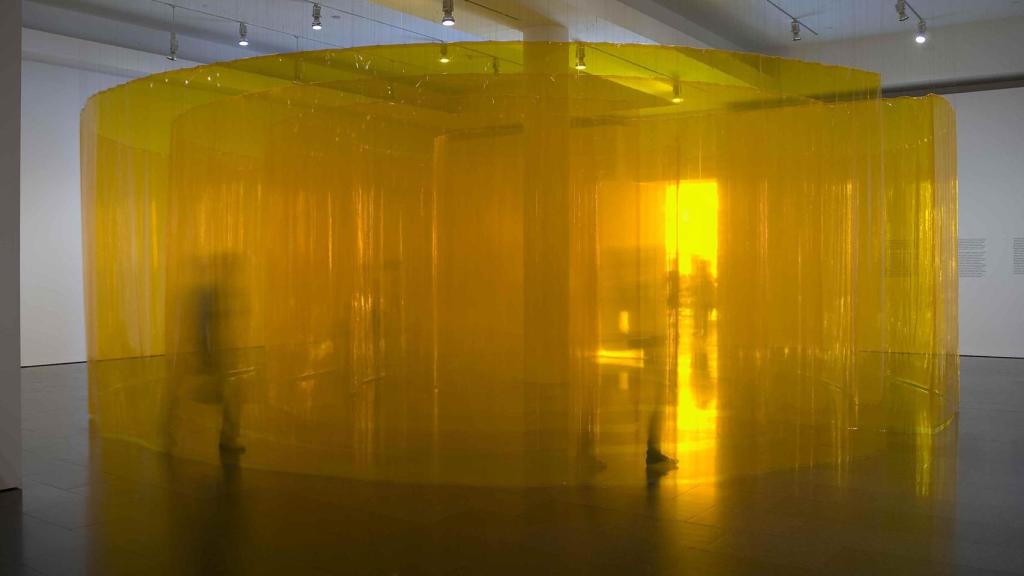
Àngels Ribé: ‘Labyrinthe’, 1969 (2011). Foto: Col·lecció MACBA. Consorci MACBA. Dipòsit de l’artista
P. Su contrato termina el año que viene. ¿Tiene planes?
R. Lo primero es celebrar el 30.º aniversario. Hay proyectos que no tienen un impacto inmediato, cuyos frutos se verán a largo plazo, y no me corresponde a mí la decisión de seguir aquí. Si me quieren, seguiré.
P. ¿Cómo aquella niña que vivía en Canarias decidió dedicarse al mundo del arte?
R. Aquella niña quería ser escritora y se vino a Barcelona a estudiar. Me decían que, si quería escribir, tenía que estudiar periodismo, pero no me cogieron; entré en Historia del Arte y empecé a trabajar con Teresa Camps, haciendo exposiciones en sitios raros del campus, y ahí decidí que no haría periodismo, sino que quería escribir sobre arte. Encontré un sujeto sobre el que escribir y una mirada con la que observar el mundo. Me encanta la literatura comparada y trabajar con los artistas.
P. ¿Y en 30 años más cómo se ve?
R. ¿¡Con 81!? [risas]. Well, writing, with my son’s grandchildren; I also have the idea of doing something with human rights. My mother is blind and I am attracted to volunteering. But, above all, I would like to always be close to art, exhibitions narrate the world. I really like to tell and I think I will continue telling things.
The post “The museum is a right, a place where experiences happen” appeared first on Veritas News.