The angle with which you sharpen a knife blade can determine the effectiveness and sharpness of the knife. No matter the type of knife or knife sharpener, sharpening angle consistency is key to creating a sharp edge. If one side of the blade is sharpened at a slightly different angle than the other side of the blade then the knife will not be as sharp or capable at cutting as it would be if you maintained the same angle for both sides of the blade.
With this in mind, it’s very important to learn how to hold the correct knife angle while you are sharpening. Once you have a firm understanding of how to hold the blade at a fixed angle, then you can worry about finding the best knife sharpening angle for your knife type and intended task. Use this guide to the best angle for knife sharpening to improve your sharpening skills.
What Knife Sharpening Angle Actually Means
Edge Angle vs Inclusive Angle
When it comes to understanding the ideal angle for your knife, there are a couple of terms that can sometimes make this process confusing, but they are actually very straightforward once you know what they mean. Edge angle is a term used to describe the angle of one side of the blade, measured from the center.
Inclusive angle is a term that describes the total angle of both sides combined, which you can think of as multiplying the edge angle by two. This is typically used when determining cutting performance. Most sharpeners use “degrees per side” (DPS) which is just an easy way of saying that they use the edge angle. This means that a 20 degree DPS angle is a 40 degree inclusive angle, with lower angles offering sharper but less durable edges, and higher angles providing more durability but less sharpness.
Why Knife Sharpening Angle Matters More Than Grit Choice
The sharpening angle is more critical than sharpener grit because it dictates the blade’s edge geometry, determining its sharpness versus durability. A low angle creates a razor-sharp but fragile edge for delicate tasks, while a higher angle forms a stronger, more durable edge resistant to chipping for heavy use.
“The grit of the stone is simply determined by how dull your knife is and how much you want to polish it,” says Lily Osman, chef and owner of Sole Cookware. Essentially, a whetstone with a lower grit is intended for a duller blade so it can remove more metal efficiently, while higher grit whetstones will remove less metal and focus more on refining the edge of the blade. However, no matter what grit you choose, you must maintain the correct angle to create a sharp, usable knife edge.
Related: 5 Best Knife Sharpeners of 2025 for Beginners and Pros, Recommended by Experts
The Best Knife Sharpening Angles
15° Per Side: Razor-Sharp Performance
The best knife angle for kitchen knives usually comes down to a discussion between a 15 vs 20 degree knife edge. Sharpening your blade at 15 degrees per side is ideal for creating a thin, razor-sharp edge intended for filleting, slicing delicate ingredients, and other tasks requiring extreme sharpness for softer materials, like you see on fillet knives and sushi knives. However, it’s important to note that this incredibly sharp edge is also less durable and more prone to micro-chipping.
20° Per Side: Balance of Sharpness and Durability
The most common option for kitchen knives when you reference a knife sharpening angle chart is about 20 degrees because at this angle you get a balance between both sharpness and durability that is perfect for the majority of everyday kitchen and food prep tasks. While this angle may not be as precise as a blade with a 15-degree edge, or as durable as a knife with a 25-degree edge, it is significantly more versatile.
25°+ Per Side: Toughness Over Sharpness
When you increase the sharpening angle, you will get a tougher, more durable blade, but you decrease the precision of the cutting edge. This is a suitable pocket knife sharpening angle and could also be used for kitchen knives that are intended to cut thicker, tougher materials, like bones. “Lower angles (12 to 15 degrees) give surgical sharpness but chip easier; higher angles (20 degrees or greater) sacrifice finesse for strength. It’s a trade-off based on how hard you push your blade,” explains Zachary Chancey, executive chef at The Alida, Savannah.
Related: How to Clean Stainless Steel Appliances for a Shiny, Streak-Free Finish
Best Sharpening Angle by Knife Type
Western Kitchen Knives
A common discussion when it comes to knife sharpening practices is the difference between Western vs Japanese knife angle. Western kitchen knives are usually made for a range of versatile tasks and tend to be used to deal with tougher materials than Japanese kitchen knives. With this intended purpose, Chancey says that “Western kitchen knives are typically sharpened at 18 degrees to 20 degrees for durability.”
Japanese Kitchen Knives
Japanese kitchen knives are typically thinner and have a sharper, more precise edge than Western knives, making them suitable for finely slicing softer materials, like sushi. Osman explains that “the angle really has to do with the style of your knife. For example, a Japanese chef knife is 15 to 17 degrees while a Western knife is 18 to 20 degrees. That’s because of what those regions are typically cutting. 17 degrees is better for fish and vegetables, 20 degrees is better if you’re cutting meat.”
Pocket Knives and EDC Knives
Pocket knives and EDC knives don’t usually need to be as precise as kitchen knives, so they will typically prioritize durability over precision sharpness. “EDC knives usually range from 20 degrees to 25 degrees for toughness,” notes Chancey. At this angle, you won’t have to worry as much about micro-chipping or rolling when you are cutting through tougher materials.
Outdoor, Hunting, and Survival Knives
Having a knife readily available when you are camping, hiking, or hunting is both convenient and, in some cases, necessary, but if you attempt to give a survival knife a razor-sharp 15-degree edge, like a sushi knife, it’s highly likely that the blade will get damaged before it can be of much use. Instead, Chancey suggests “survival knives should be sharpened at a 25 degree to 30 degree angle for rugged use.”
Serrated Knives
Many people neglect to sharpen their serrated knives, but to ensure that you knives can continue to cut effectively, it’s recommended to regularly sharpen even serrated blades. This can usually be done by using a sharpening rod that matches the size of edge serration. Chancey states that when sharpening “serrated knives you should maintain the factory angle, which is usually 20 degrees, and sharpen only the beveled side.”
Related: Stop Fighting a Dull Blade: How to Sharpen Your Pocket Knife at Home
Sharpness vs Durability: Choosing the Right Knife Sharpening Angle
Thinner Edges and Cutting Performance
Selecting an angle for your knife comes with an obvious trade-off, since thinner edges are easier to cut with, but lack the same level of durability as a thicker edge. When you give a blade a thinner edge, you can expect to have a higher degree of cutting performance that is ideal for slicing through softer materials, like fish. However, if the force required to cut through a material is too great, then the low durability could increase the risk of micro-chipping. Typically, thinner edges are best for precision tools, like sushi knives and fillet knives.
Thicker Edges and Edge Retention
Having a thicker edge to your knife will help ensure that it can tackle tough cutting tasks without the edge chipping or rolling while in use. Additionally, these blades will typically retain their cutting edge for longer than a knife with a thinner, more fragile cutting edge. Though, the thickness of the cutting edge will limit the precision and cutting performance of the blade, so these knives are best for cutting hard vegetables and tough meats, rather than attempting to use them for cutting tasks that require finesse.
How Steel Hardness Changes Angle Choice
The hardness of the steel can have a significant impact on what angle you choose to give to a knife blade. The harder the steel, the easier they hold sharper, lower-angle edges without chipping, making these blades best for precision cutting with a thin, razor-sharp edge. Softer steels are generally given a wider, higher angle edge that increases the durability of the blade and reduces the risk of chipping or rolling, making these knives better for rougher cutting tasks.
Getty Images
How to Find and Hold the Correct Sharpening Angle
The Coin Method
As indicated by the name, the coin method uses coins to help hold the correct angle for sharpening a knife on a whetstone. This is done by placing the flat side of the blade on the whetstone, then stacking coins, like pennies or quarters, under the spine (the back) of the blade.
Since the spine of the blade will be elevated, this will change the angle at which the cutting edge touches the whetstone, while the coins will create a physical, consistent ramp for the blade, giving beginners a reliable, repeatable guide for common angles, so that you don’t sharpen too steep or shallow. For instance, two to three pennies under the spine of the blade will usually be enough for sharpening at a 15 to 20 degree angle.
Angle Guides and Jigs
Angle guides are small clips or rails that attach to the sides of a sharpening stone or rod to create a physical barrier that keeps the blade set at the ideal angle while you sharpen the knife. Jigs are devices that securely hole the knife blade at a precise, consistent angle to a sharpening stone, eliminating guesswork and ensuring repeatable, accurate results. For this reason, both angle guides and jigs are highly useful for both beginners and professionals who may not have the time to carefully freehand sharpen their blades in a busy kitchen.
Muscle Memory and Visual Cues
Finding and holding a consistent knife sharpening angle is the most challenging part of freehand sharpening, but over time you can develop muscle memory that, when used alongside visual cues, can help you find and sharpen at a consistent angle, reducing the need for sharpening aids, like angle guides and jigs. Unfortunately, muscle memory is not something that you develop in an instant, so it will take time, patience, and practice until your body gets used to holding a consistent angle while you sharpen.
During this practice period, it’s a good idea to use visual cues, like coloring the entire angled edge with a marker. Make a few passes on the whetstone and check the marker. If the marker is removed evenly, then the angle is correct, but if the marker is removed just at the top, closer to the spine, the angle is too high, while the angle is too low if the marker is removed just at the bottom, near the edge.
Why Consistency Beats Precision
Maintaining a consistent angle is more important than achieving a mathematically perfect, precise angle when sharpening knives. Consistency ensures an even, durable, and truly sharp edge, whereas focusing solely on precision often leads to rounded, uneven edges. Focus on feeling the same angle every time. A “good enough” angle that is consistent will always outperform a “precise” angle that changes.
Related: How to Remove Rust From Cast Iron and Re-Season Your Skillets and Pans
How Your Knife Sharpening Method Affects Angle Choice
Whetstones
The most versatile method for sharpening your knife blades is to use a whetstone. This gives you the freedom to set the angle, allowing for precise, custom edges based on the type of knife and uses. However, the main drawback of this method is that it requires significant skill to sharpen a blade properly with a whetstone, especially when it comes to finding and holding the correct angle, though you can use an angle guide or jig to help control the angle of the blade until you become more comfortable with using a whetstone.
Guided Knife Sharpening Systems
Professional kitchens may have a guided sharpening system set up that makes it easy to adjust the angle of the blade and fix the position of the knife, ensuring accurate and consistent sharpening. Though, the high cost of these guided sharpening systems often makes them an unrealistic option for a home cook who may only need to sharpen their knives once every two to three months.
Pull-Through Knife Sharpeners
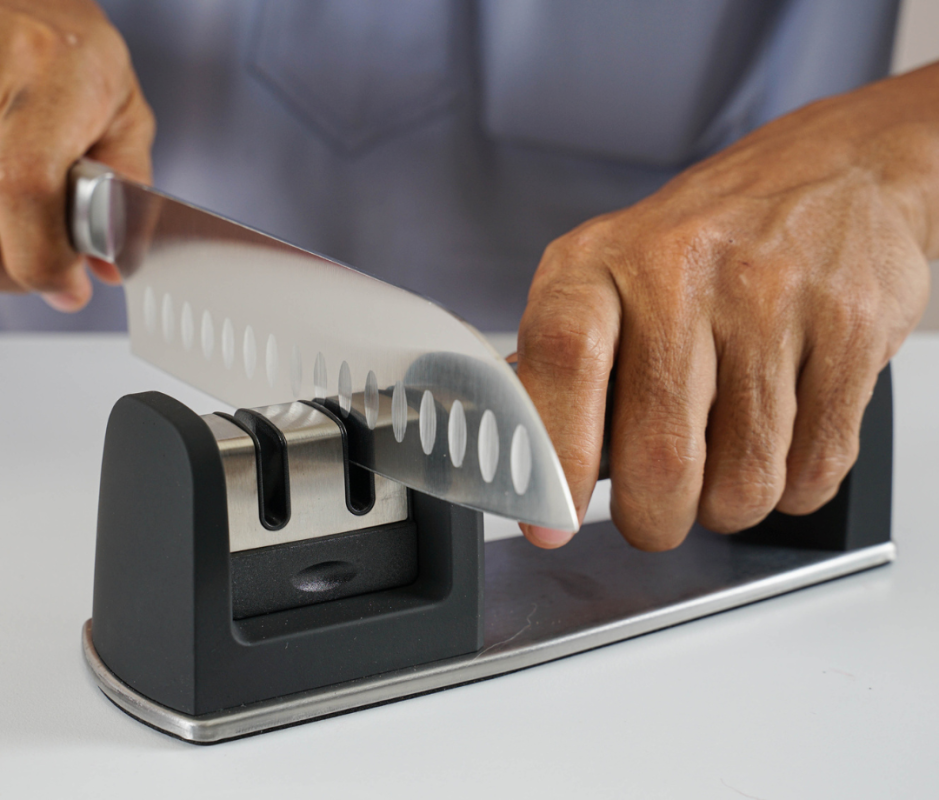
A pull-through sharpener will generally have one or more sharpening slots, each with a preset angle. “Stones allow precision at any angle, while pull-through sharpeners often lock you into preset angles. Know your tool before you commit,” says Chancey. With this in mind, it’s important to pay attention to the pre-set sharpening angles when you are purchasing and using a pull-through sharpener so that you don’t accidentally sharpen a 20-degree blade with a 15-degree slot, or make a similar mistake that could dull or damage the knife.
Professional Knife Sharpening Services
Generally, professional sharpening services will use an advanced, guided sharpening system or whetstones to deliver optimal sharpness and consistent edge geometry to maximize the knife’s potential. The obvious drawback to using professional services is that you will be paying for each knife you sharpen and each time that a knife needs to be resharpened, which usually makes professional sharpening an option that only established businesses and restaurants will seek out.
Related: How to Sharpen Scissors at Home for Effortless Cutting
Common Knife Sharpening Angle Myths
“Lower Angle is Always Better”
The myth that a lower knife angle is always better is simply not true. Rather, it is more important to balance between sharpness and durability, especially for the vast majority of kitchen and food prep tasks. Lower angles slice more easily but may chip or roll easier, while higher angles offer greater toughness for heavy tasks but cut less efficiently, meaning the ideal angle depends on the knife’s steel type, intended use, and the user’s preference for edge retention or cutting performance.
“Factory Angle Must Be Preserved Exactly”
The idea that a factory knife angle must be preserved exactly is a widely held, yet largely debunked, myth in the knife community. While manufacturers apply a specific angle for efficiency, consistency, and durability during production, users can often achieve superior performance and better long-term maintenance by setting their own preferred angle.
“You Need Perfect Angles to Get Sharp”
You don’t need perfect angles for a sharp knife edge, but consistent angles are key. The core truth is in finding the right range for your knife’s steel and task, often using guides to build muscle memory, then refining. It’s important to understand that slight variations (+/- one to two degrees) are fine for good results, especially for a home cook who is just learning how to sharpen their knives.
Related: Stop Using Dull Knives Now: The Beginner Whetstone Guide Chefs Swear By
Signs Your Knife Sharpening Angle Is Wrong
Knife Edge Dulls Too Quickly
If you find that the edge initially feels sharp but after minimal use the knife feels dull again, this could be due to creating a fragile edge that bends or rolls over easily. Similarly, Osman notes that a clear sign the sharpening angle is wrong is if the knife has “a dull, rounded edge that won’t bite into a thumbnail or piece of paper.” This can often happen if the angle is too high or the angle is inconsistent.
Micro-Chipping or Rolling
A common sign that you have put too fine an edge on a blade is that the knife becomes prone to micro-chipping or rolling. Chancey mentions that “if the edge feels sharp but folds under pressure, your angle is too low.” This can also occur if the angle with which you sharpen the blade is inconsistent, since creating an uneven edge can cause the blade to catch in spots and weaken over the inconsistent areas.
Difficulty Forming a Burr
The burr refers to a thin, folded-over edge of metal that forms on the opposite side of the blade from where you are sharpening. Forming a burr is a sign that you are removing metal from the blade in a consistent and even pattern. Osman explains that your sharpening angle is likely wrong if you have “difficulty creating a burr, or if the burr is inconsistent along the length of the blade.”
Best Knife-Sharpening Angle for Beginners
Why 20° Per Side is the Safest Starting Point
A 20 degree angle per side is great for beginners because it’s a versatile “sweet spot,” balancing sharpness with edge durability. This angle is ideal for most kitchen knives, offering good performance for slicing and dicing without being too fragile like lower angles or too dull for heavier use like higher angles.
It’s a safe starting point for standard Western knives, providing stability for learning, while lower angles suit hard Japanese knives and higher angles suit heavy-duty tasks. Ultimately, a 20 degree angle per side on your blades offers the best all-around compromise for general cooking.
When to Experiment With Lower Angles
While it is good to start with an average 20-degree angle for beginners, there are some instances where you should focus on sharpening at lower angles, such as when you need a razor edge for slicing soft foods. You may also want to experiment with lower angles if your knife steel is very hard and can hold a fine edge without chipping.
Just keep in mind that while lower angles provide superior slicing ability, they have a reduced level of edge retention and durability, so only sharpen knives with a lower angle when there is an actual need for a razor-sharp, but fragile edge, such as for sushi prep or filleting.
Related: How To Use a Honing Steel To Keep Your Knives Razor-Sharp
Knife Sharpening Angle FAQs
Can You Change a Knife’s Factory Angle?
You can change a knife’s factory sharpening angle, but it’s a good idea to start at or near the factory angle and adjust based on use. To do this, you simply need to remove more metal when sharpening to create a new bevel, with lower angles cutting better but lacking durability and higher angles having superior durability but a duller edge.
Is 15° Too Sharp for Home Use?
A 15-degree knife blade isn’t too sharp for home use, though whether it will be effective for your usual cooking tasks depends on how you use it. This lower angle is considered a more delicate, high-performance angle suitable for specific types of knives. While a 15-degree angle provides a razor-sharp, effortless cut, it is less durable than the traditional 20-degree angle used on many Western knives.
Do Different Stones Require Different Angles?
Different whetstones don’t require different angles. The angle is determined by the knife’s type and intended use, such as 15 to 20 degree angles for most kitchen knives. For a single knife, you should be using the same angle across all your grit stones (coarse to fine) to maintain that specific bevel for the blade.
Does Honing Change the Edge Angle?
Generally, honing is not intended to change the edge angle. Its primary purpose is to realign, straighten, or polish the existing edge, not to remove significant amounts of metal. However, if you hone the blade with a diamond rod, then these abrasive tools may remove a small amount of metal, potentially changing the edge angle slightly if you overdo it.